
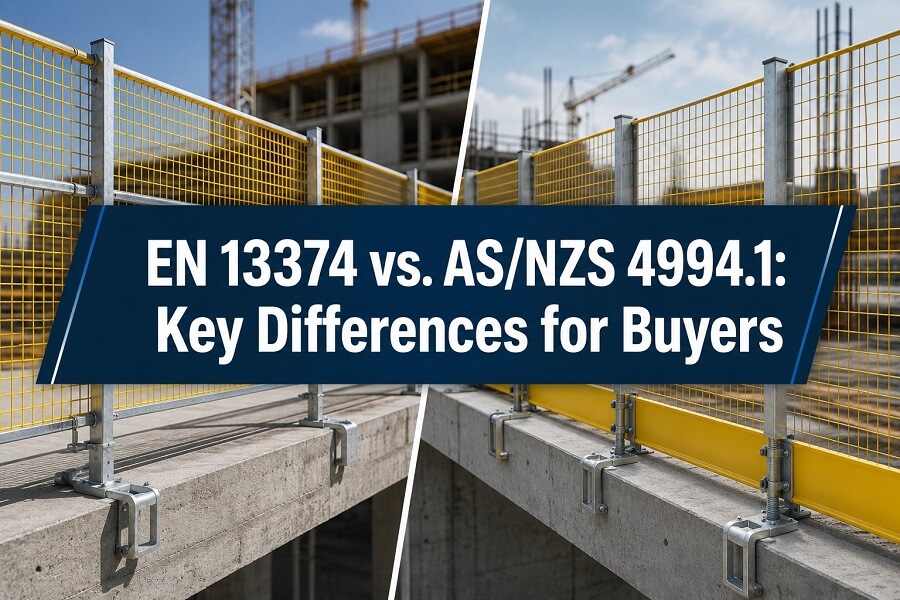
EN 13374 vs. AS/NZS 4994.1: Key Differences for Buyers
Temporary edge protection systems may look similar across different construction markets.
A steel post, mesh barrier, guardrail, slab attachment, or parapet clamp can often be used in comparable site conditions. However, similar product appearance does not mean the same system automatically satisfies the requirements of every regional standard.
For buyers sourcing temporary edge protection for Europe, the United Kingdom, Australia, or New Zealand, two standards are frequently referenced:
- EN 13374:2025
- AS/NZS 4994.1:2023
Both address temporary edge protection, but they differ in scope, application structure, classification logic, testing framework, and supporting installation requirements.
The current EN 13374 edition was published in 2025 and covers temporary edge protection systems used during the construction or maintenance of buildings and other structures. It applies to flat and inclined surfaces and defines three classes of temporary edge protection.
AS/NZS 4994.1:2023 establishes general requirements for the design, manufacture, installation, and testing of temporary edge protection equipment used on roofs with slopes not greater than 35 degrees and at other exposed edges.
For procurement teams, the key question is therefore not:
Which standard is stricter?
A better question is:
Which standard applies to the project, system configuration, installation method, and local regulatory environment?
EN 13374 and AS/NZS 4994.1 at a Glance
| Comparison Point | EN 13374:2025 | AS/NZS 4994.1:2023 |
| Primary market | Europe and national markets adopting the European standard | Australia and New Zealand |
| Main focus | Product specifications and test methods for temporary edge protection systems | General requirements for design, manufacture, installation, and testing |
| Surface conditions | Flat and inclined surfaces | Roofs up to 35 degrees and other exposed edges |
| Classification approach | Three temporary edge protection classes | Does not use the same direct Class A, B, and C structure |
| Fall-arrest consideration | Includes energy-absorption requirements for systems with an arrest function | Requirements are structured around Australian and New Zealand applications and system configurations |
| Installation guidance | Product requirements must be combined with project-specific installation instructions and applicable local rules | Supported by separate parts covering roof edges and non-roof edges |
| Automatic equivalence | No | No |
The two standards should not be treated as interchangeable test labels. A report prepared for one standard cannot simply be renamed or reformatted to demonstrate conformity with the other.
What Is EN 13374:2025?

EN 13374:2025 is titled:
Temporary Edge Protection Systems — Product Specification — Test Methods
It applies to temporary edge protection used during construction and maintenance work on buildings and other structures.
The standard covers systems used on both flat and inclined surfaces and specifies three classes of temporary edge protection. Where a system is intended to arrest a person falling or sliding down an inclined surface, the standard also addresses energy absorption.
The scope includes different types of systems, including:
- Systems mechanically fixed to a structure
- Systems relying on gravity
- Systems relying on friction on flat surfaces
- Systems intended for flat or inclined working areas
However, EN 13374 does not cover every type of barrier or fall-protection application.
Its stated exclusions include systems intended to protect against vehicle impact, mobile equipment impact, sliding bulk materials, snow, or risks in areas accessible to the public. It also does not apply to scaffold side protection covered by EN 12811-1 or EN 1004-1.
The Importance of EN 13374 Classes
One of the most recognisable features of EN 13374 is its three-class structure.
The classes are intended to distinguish between different application conditions and performance demands. Factors such as surface inclination, potential sliding or falling movement, and the required energy-absorption capability affect which class is appropriate.
For buyers, specifying only “EN 13374 compliant” is therefore incomplete.
The supplier should identify:
- The applicable class
- The tested system configuration
- The intended surface condition
- The fixing or attachment method
- The maximum permitted post spacing
- The substrate used during assessment
- Any limitations stated in the test or technical documentation
A system assessed for one class or configuration should not automatically be assumed suitable for every EN 13374 application.
What Is AS/NZS 4994.1:2023?
AS/NZS 4994.1:2023 is titled:
Temporary Edge Protection, Part 1: General Requirements
It specifies requirements for the design, manufacture, installation, and testing of temporary edge protection equipment.
Its scope includes equipment used:
- On roofs with slopes not greater than 35 degrees to the horizontal
- At other exposed edges
- Before permanent walling materials have been installed
Unlike EN 13374, the Australian and New Zealand framework is organised as a series of related documents.
The main parts include:
- AS/NZS 4994.1:2023: General requirements
- AS/NZS 4994.2:2023: Roof edge protection installation and dismantling
- AS/NZS 4994.3:2023: Installation and dismantling for edges other than roof edges
- AS/NZS 4994.4:2018: Perimeter protection screens
AS/NZS 4994.2 provides requirements and guidance for selecting, installing, using, and dismantling roof edge protection that conforms to Part 1. AS/NZS 4994.3 addresses exposed floor edges, platform edges, floor openings, and similar non-roof applications.
This means Australian and New Zealand buyers should not evaluate the product only against Part 1. The proposed installation method and project application may also need to be considered against Parts 2 or 3.
Key Difference 1: The Applicable Market
The most immediate difference is geographical application.
EN 13374 is primarily used in European markets and in other countries or projects that adopt European temporary works specifications. National editions may carry an additional prefix, such as BS EN 13374 in the United Kingdom.
AS/NZS 4994.1 is developed for Australia and New Zealand and should be considered together with the relevant local workplace safety requirements, codes of practice, regulator guidance, and project specifications.
A European test report may provide useful engineering evidence for an Australian buyer, but it does not automatically demonstrate that the system satisfies AS/NZS 4994.1.
Safe Work Australia explains that international standards may sometimes be considered alongside Australian standards, particularly where they provide an equivalent or higher level of safety. However, where Australian law specifically requires an Australian standard, the applicable Australian standard should be used.
Buyer Takeaway
The project location should be identified before the supplier recommends a system or submits compliance documents.
A buyer should provide:
- Destination country
- State, territory, or regional jurisdiction
- Project specification
- Required standard and edition
- Intended application
- Principal contractor or engineering requirements
Key Difference 2: Classification Logic
EN 13374 uses three temporary edge protection classes.
This classification structure helps connect the system’s performance requirements with the intended working surface and potential fall or sliding conditions.
AS/NZS 4994.1 does not use the same direct Class A, Class B, and Class C structure. Its requirements are organised around the Australian and New Zealand temporary edge protection framework, including roof applications, exposed edges, equipment configurations, and associated installation practices.
Therefore, there is no reliable one-to-one statement such as:
EN 13374 Class A equals AS/NZS 4994.1.
Even where products appear similar, the standards may use different:
- Test arrangements
- Load application positions
- Deflection criteria
- System configurations
- Installation assumptions
- Acceptance conditions
- Reporting requirements
Buyer Takeaway
Do not accept a supplier’s statement that a system meets both standards solely because it passed one type of load test.
Ask for separate evidence showing how the system has been assessed against each claimed standard.
Key Difference 3: Scope of the Standards
EN 13374 focuses strongly on product specifications, system classification, performance, and test methods.
AS/NZS 4994.1 expressly covers design, manufacture, installation, and testing. It also sits within a wider series that separates general equipment requirements from roof and non-roof installation practices.
The 2023 revision of the AS/NZS series also clarified several areas. Industry guidance on the revision notes that the scope was aligned with perimeter protection screens, configuration provisions were expanded to consider material conveyors, and the testing appendix was updated for clarity.
This broader series structure is important because many site failures are not caused by the guardrail post or mesh panel alone.
Failures may result from:
- An unsuitable slab attachment
- Weak or damaged concrete
- Incorrect anchor selection
- Excessive post spacing
- Poorly tightened clamps
- Missing locking pins
- Unapproved component combinations
- Installation outside the tested configuration
Buyer Takeaway
A product certificate is not enough without installation information.
The buyer should also review:
- Installation manuals
- Approved component combinations
- Structural fixing requirements
- Substrate limitations
- Inspection procedures
- Dismantling instructions
- Site-specific design information
Key Difference 4: Roof and Inclined-Surface Applications
Both standards address inclined working conditions, but they structure these requirements differently.
EN 13374 applies to flat and inclined surfaces and includes energy-absorption requirements where the system has an arrest function, such as stopping a worker who falls or slides down a sloping roof.
AS/NZS 4994.1 applies to roofs with slopes not greater than 35 degrees, while AS/NZS 4994.2 provides additional requirements and guidance for the selection, installation, use, and dismantling of roof edge protection.
A system suitable for a flat concrete slab should not automatically be assumed suitable for a pitched roof.
Inclined-surface applications may create additional requirements relating to:
- Potential sliding distance
- Barrier height relative to the working surface
- Energy absorption
- Roof bracket positioning
- Fixing strength
- Guardrail or mesh configuration
- Distance between the working surface and barrier
- Safe installation and dismantling access
Buyer Takeaway
The supplier should know whether the system will be used on a slab, staircase, roof, formwork deck, platform, or another exposed edge.
“Temporary edge protection” alone is not a complete application description.
Key Difference 5: The Tested System Configuration
Temporary edge protection should be evaluated as a system rather than as a collection of independent components.
A typical system may include:
- Beiträge
- Guardrails or mesh barriers
- Toe boards
- Slab grabs
- Parapet clamps
- Bolt-down bases
- Cast-in sockets
- Formwork attachments
- Locking wedges or pins
- Anchors and fasteners
Changing one component can change the behavior of the complete system.
For example, a post tested with a cast-in socket should not automatically be assumed to provide the same performance when installed with a parapet clamp. The post may be identical, but the load path, connection stiffness, substrate, and possible failure mode are different.
The same issue applies when changing:
- Post spacing
- Barrier height
- Mesh dimensions
- Steel thickness
- Anchor type
- Concrete strength
- Edge distance
- Clamp opening
- Installation direction
Buyer Takeaway
The test report should clearly show the configuration that was assessed.
Product photographs, drawings, component numbers, dimensions, material specifications, fixing details, and test setup should match the system being purchased.
Key Difference 6: Testing and Engineering Evidence
Buyers frequently receive several different types of technical evidence, but these documents do not have the same meaning.
Design Calculations
Engineering calculations may be used to assess load paths, stresses, connection forces, and structural capacity.
Finite Element Analysis
Finite element analysis can help evaluate stress distribution, displacement, and potential areas of weakness. It is useful during product development and engineering review.
However, an internal simulation report should be clearly identified as a simulation-based engineering analysis. It should not be presented as a third-party physical test report or independent certification.
Internal Physical Testing
Testing conducted by the manufacturer may provide valuable quality and product-development evidence. Buyers should still review the equipment, procedure, calibration, test configuration, acceptance criteria, and personnel responsible for the test.
Witnessed Testing
A customer, engineer, inspection company, or testing organisation may witness the test and confirm how it was performed.
Accredited Laboratory Testing
An accredited laboratory report generally offers stronger independent evidence, provided that the accreditation scope, test method, product configuration, and applicable standard are relevant.
Buyer Takeaway
Ask the supplier to state exactly what each document represents.
Avoid vague descriptions such as:
- Certified system
- European-standard product
- Australian-standard design
- Tested quality
- Engineer-approved
Instead, request precise wording such as:
- Tested to a specified clause and edition
- Assessed by calculation
- Internally tested
- Witnessed by a named organisation
- Tested by an accredited laboratory
- Reviewed for a defined configuration
Can One Edge Protection System Meet Both Standards?
Potentially, yes.
A well-designed temporary edge protection system may be capable of satisfying requirements for more than one market. However, this requires more than using the same steel post or mesh barrier.
The manufacturer may need to assess or test different:
- Attachments
- Post spacings
- Barrier configurations
- Fixing methods
- Substrates
- Load cases
- Installation arrangements
The supporting documents may also need to be prepared separately for each standard and target market.
Buyers should therefore distinguish between:
- A product that appears suitable for both markets
- A product that has engineering evidence relevant to both standards
- A product that has been fully assessed in the required configurations against both standards
These are not the same claim.
What Documents Should Buyers Request?
Before placing an order, buyers should request a technical documentation package appropriate to the project.
The package should normally include:
- The exact standard and edition being claimed
- The applicable system class or application category
- Product and assembly drawings
- Material specifications
- Component identification
- Test or assessment reports
- Installation instructions
- Maximum post spacing
- Approved attachment methods
- Substrate and anchor requirements
- Inspection and maintenance instructions
- Product limitations
- Batch inspection or quality-control records
- Traceability information
- Details of any components excluded from the assessment
The buyer should also confirm whether the evidence applies to the exact commercial product being supplied.
A test report for an earlier post design, different mesh panel, thicker tube, alternative welding detail, or different attachment may not represent the current production configuration.
Questions to Ask an Edge Protection Supplier
Before approving a supplier, ask:
Which Standard and Edition Does the System Address?
The supplier should state the complete designation, such as EN 13374:2025 or AS/NZS 4994.1:2023.
Which Configuration Was Tested?
Ask for drawings and photographs showing the exact posts, barriers, attachments, fixings, and spacing.
Does the Evidence Cover the Complete System?
A component test does not necessarily establish the performance of the assembled edge protection system.
Was the Test Physical or Simulation-Based?
Both can provide useful information, but they should be clearly distinguished.
Who Conducted or Witnessed the Test?
Check the organisation, laboratory, engineer, accreditation status, and scope of work.
What Are the Installation Limitations?
Ask about concrete strength, slab thickness, anchor type, edge distance, clamp capacity, roof slope, post spacing, and other restrictions.
Can Components Be Mixed?
Do not assume posts, barriers, clamps, or bases from different systems can be combined safely.
How Is Production Consistency Controlled?
Request information about steel traceability, welding inspection, dimensional inspection, coating checks, load testing, sampling, and batch records.
Standards Do Not Replace Site Risk Assessment
Meeting a product standard does not remove the responsibility to assess the actual construction site.
Safe Work Australia notes that conformity with a standard does not automatically establish compliance with all workplace health and safety duties. Additional controls may still be required depending on the circumstances and risks.
Site teams should also evaluate:
- Condition of the supporting structure
- Openings and irregular edges
- Wind exposure
- Material handling activities
- Vehicle or plant movement
- Installation access
- Changes to the structure
- Missing or damaged components
- Inspection frequency
- Interaction with formwork and other temporary works
A compliant product can still become unsafe when installed incorrectly or used outside its intended configuration.
Final Comparison for Buyers
EN 13374:2025 and AS/NZS 4994.1:2023 share the same broad safety objective: preventing people and objects from falling from exposed edges during construction and maintenance.
However, they approach product selection, classification, testing, and installation through different regional frameworks.
EN 13374 uses a three-class system and covers temporary edge protection for flat and inclined surfaces, including energy-absorption requirements where the system has a fall-arrest function.
AS/NZS 4994.1 provides general design, manufacturing, installation, and testing requirements for temporary edge protection used on roofs up to 35 degrees and at other exposed edges. It is supported by separate documents addressing roof and non-roof installation.
For buyers, the most important principles are:
- Select the standard according to the project market.
- Specify the exact standard edition.
- Do not assume direct equivalence between the two standards.
- Review the tested configuration, not just the product name.
- Verify attachments, spacing, substrate, and installation limits.
- Distinguish calculations and internal simulations from independent physical testing.
- Confirm that production goods match the assessed design.
- Combine product evidence with site-specific risk assessment.
The safest procurement decision is not based on the supplier making the broadest compliance claim.
It is based on the supplier providing the clearest connection between the product, application, test evidence, installation method, and requirements of the target market.
Need Help Selecting an Edge Protection System?
APAC provides modular temporary edge protection systems for concrete frames, slab edges, parapets, stairways, formwork decks, roofs, and other construction applications.
Our team can help buyers review system configurations, attachments, technical drawings, production quality-control documents, and available engineering evidence according to the intended project application.
Before requesting a quotation, provide the project country, required standard, application drawings, supporting structure, proposed attachment method, edge length, and expected installation conditions. This allows the system configuration to be evaluated more accurately.
Important notice: This article provides a general purchasing comparison and does not reproduce the complete technical requirements of either standard. Buyers, designers, contractors, and engineers should obtain the official current standards and confirm project-specific requirements with the relevant regulator, engineer, testing body, or competent person.
 DE
DE  EN
EN  SV
SV  IT
IT  FR
FR  ES
ES  AR
AR  FI
FI  LV
LV  ET
ET