Introduction
Concrete edge protection can be fixed in different ways, slab grab and bolt-down systems are two common options. Both can provide effective temporary protection, but their installation methods, site requirements, and overall project costs can be quite different.
Here are seven practical factors to compare before deciding which fixing method better suits your project.
What Is Slab Grab Edge Protection?
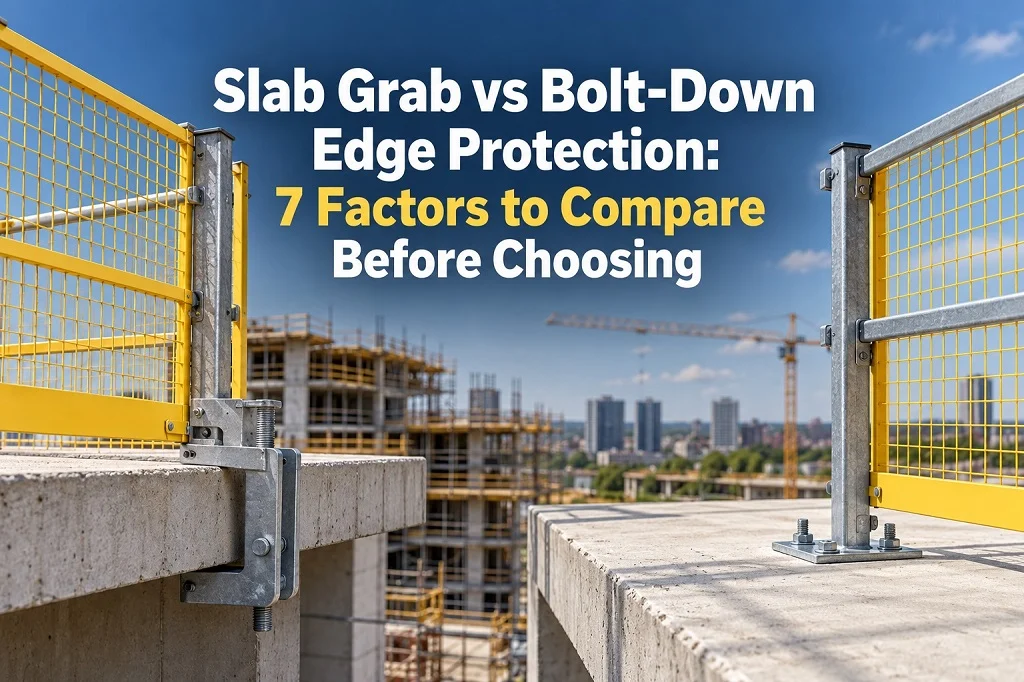
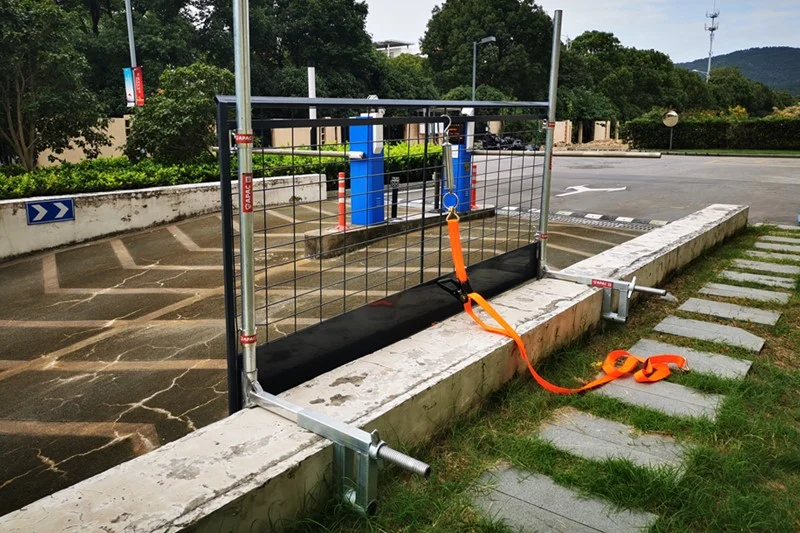
A slab grab edge protection system uses an adjustable clamp to grip a suitable concrete slab edge or upstand. Instead of fixing the attachment into the concrete with an anchor, the clamp provides the connection point for the post and barrier.
This makes slab grab systems particularly useful where drilling is undesirable or where the protection needs to be removed and repositioned repeatedly.

For example, APAC’s Slab Grab Edge Protection System uses a multi-slab clamp that can be installed horizontally or vertically and adjusted to suit different slab thicknesses.
Typical characteristics include:
- No drilling for the slab clamp itself
- Adjustable clamping range
- Removable and reusable fixing
- Relatively easy repositioning
- Need for a suitable and accessible slab edge
The slab condition still matters. Thickness, geometry, surface condition, and available clamping area should all be checked before choosing the system.
What Is Bolt-Down Edge Protection?
Bolt-down edge protection uses a socket base, foot, or bracket mechanically fixed to the concrete structure. The post and barrier are then installed onto that fixed attachment.

APAC’s Safedge Bolt Down Edge Protection System, for example, uses socket bases anchored into the concrete slab as fixing points for the safety posts and mesh barriers.
This approach can work well when the protection is expected to remain in the same location for a longer period or when a compact fixing point is preferred.
However, bolt-down installation normally introduces additional considerations such as drilling, anchor selection, hole preparation, concrete condition, fixing location, and removal after use.
Slab Grab vs Bolt-Down Edge Protection: Quick Comparison
| Factor | Slab Grab | Bolt-Down |
| Fixing method | Clamps onto slab edge | Mechanically anchored into concrete |
| Drilling | Normally not required | Usually required |
| Repositioning | Generally easier | Fixing process normally repeated |
| Concrete penetration | None from clamp | Anchor penetrates concrete |
| Slab-edge access | Required | Depends on fixing position |
| Reuse | Clamp can be redeployed | Base may be reusable; anchors may be consumable |
| Typical fit | Repetitive floor cycles, no-drill applications | Fixed or longer-duration layouts |
Neither method should automatically be described as stronger, safer, or better. Performance depends on the complete system configuration, attachment, substrate, spacing, installation procedure, and project conditions.
1. Installation Speed
Installation speed is often the first practical difference between the two systems.
A slab grab normally removes several operations associated with mechanical anchoring. The installer positions the clamp on a suitable slab edge, adjusts and secures it according to the manufacturer’s instructions, and then installs the post and barrier.
A bolt-down system usually involves more steps. The fixing position needs to be identified, the concrete drilled, the hole prepared, the specified anchor installed, and the base secured before the remaining edge protection components are added.
For a short protection line, the difference may be relatively small.
But consider a high-rise concrete frame where the same edge protection system follows the construction cycle from one floor to the next. Installation work that is repeated on every level can become an important part of the overall program.
Avoiding repeated drilling can therefore make slab grab systems attractive for fast floor cycles.
That does not mean bolt-down systems are slow by definition. If the protection is installed once and remains in position for a long time, the additional installation steps may have little effect on the total project schedule.
2. Drilling Requirements
One of the most useful questions to ask early is:
Can we drill into the concrete?
For many projects, drilling is completely acceptable. On others, it may be restricted because of reinforcement, embedded services, waterproofing, finished concrete surfaces, structural requirements, or project specifications.
Where drilling is restricted, a suitable slab grab system can offer a simpler fixing approach.
There is also a work-process consideration. Drilling concrete can generate respirable crystalline silica dust. HSE identifies drilling as one of the common construction activities capable of producing silica-containing dust and provides specific control guidance for drilling and coring operations.
This does not mean bolt-down systems should be avoided. It simply means drilling, dust control, tools, consumables, and site procedures should be included in the comparison.
When reviewing a project, do not ask only whether drilling is technically possible. Ask whether it fits the site’s normal working method.
3. Slab Condition and Fixing Location
Neither system should be selected without understanding the actual concrete structure.
For a slab grab system, check:
- Slab thickness
- Edge geometry
- Available clamping surface
- Accessibility from the installation position
- Surface condition
- Obstructions around the edge
For a bolt-down system, the questions are different:
- Is the concrete suitable for the specified anchor?
- Where can the fixing point be located?
- What edge distance is required?
- Are reinforcement or embedded services present?
- What drilling depth is required?
- Which anchor is specified for the system?
This is why total edge length alone is usually not enough information for an accurate edge protection quotation.
Drawings, slab dimensions, edge details, and fixing restrictions should ideally be reviewed before the system is selected.
4. Repositioning Between Floors
Repositioning matters most on repetitive concrete-frame construction.
Imagine one set of temporary edge protection moving through the building:
Level 4 → Level 5 → Level 6 → Level 7
The useful question is not simply:
How quickly can we install the system once?
A better question is:
How much installation work must be repeated every time the system moves?
With a slab grab system, the basic cycle is typically to release the clamp, move the components, and reinstall them on another suitable slab edge.
With a mechanically anchored bolt-down system, the new location normally requires another fixing and anchoring process.
On projects with short concrete floor cycles, reducing repeated installation operations can improve workflow.
On the other hand, if protection stays on one level for several months, ease of repositioning may be much less important.
The construction sequence should therefore be considered before choosing the fixing method—not after the products arrive on site.
5. Total Installed Cost
Comparing the price of one slab clamp against the price of one socket base does not tell you which system is more economical.
The more useful figure is total installed cost.
That may include:
- Clamp or socket-base price
- Anchors
- Drill bits and other consumables
- Installation labor
- Removal labor
- Concrete repair where required
- Number of reuse cycles
- Transportation
- Storage
- Replacement of lost or damaged components
A slab grab may be a larger and mechanically more complex component than a compact bolt-down socket base. Its individual purchase price may therefore be higher.
But if the same clamp is repeatedly moved through many floors without requiring new drilled fixing points, the economics can change.
Likewise, a low-cost bolt-down base should not automatically be treated as the lower-cost system if every new position also requires drilling, anchors, labor, and related site operations.
For contractors, rental businesses, and buyers purchasing systems for repeated use, lifecycle cost usually gives a better comparison than component price alone.
6. Storage, Transport, and Reuse
Edge protection systems spend a surprising amount of ti
me being transported, stored, counted, moved between floors, and returned to the yard.
That makes logistics part of the buying decision.
Slab grab clamps are generally larger than simple socket bases. A large fleet may therefore require more consideration around stillages, transport space, site storage, and handling.
Their advantage is reuse. Where project conditions allow, the same clamp can be removed and redeployed repeatedly.
Bolt-down socket bases are usually compact and straightforward to pack in quantity. However, depending on the fixing system, anchors and other consumables may need to be replenished as the protection moves.
Before comparing the two, ask:
How many floors or future projects will this equipment serve?
For a one-off application, one commercial model may make sense.
For a rental fleet or a contractor using the same system across multiple projects, the answer may be very different.
You can also review APAC’s wider Concrete Edge Protection Systems to compare different fixing approaches for concrete structures.
7. Compliance and System Compatibility
Compliance should be assessed at the system level, not just by looking at an individual clamp or base.
BS EN 13374:2025 is the current British Standard for temporary edge protection systems. It specifies requirements and test methods for systems used during construction or maintenance and includes systems fixed to structures as well as systems relying on gravity or friction.
Instead of asking only:
Is this component EN 13374 compliant?
ask:
- Which complete system configuration was tested?
- Which attachment was used?
- Which post was included?
- What post spacing applies?
- Which mesh barrier or guardrail was tested?
- What installation conditions apply?
- Are there limits on slab dimensions or fixing positions?
Changing one part of the configuration can matter.
For example, changing the attachment, increasing the spacing between posts, or combining components that were not designed to work together should not automatically be treated as equivalent to the original system.
HSE guidance on temporary works also states that temporary structures need to be designed, installed, and maintained to withstand foreseeable loads, and that manufacturers’ instructions should be followed when selecting and using temporary works equipment.
For buyers, this means the technical question is not simply whether the product carries a standard reference. The more useful question is whether the exact configuration proposed for the project has appropriate evidence and installation guidance behind it.
So, Which One Should You Choose?
There is no universal winner.
A slab grab may be a better fit when:
- Drilling is restricted or undesirable
- The protection moves frequently
- Floor cycles are relatively fast
- Preserving the concrete surface is important
- The slab edge is accessible and suitable for clamping
- The same attachments will be reused repeatedly
A bolt-down system may be a better fit when:
- Mechanical anchoring is permitted
- Protection will remain in position for longer
- A compact fixing point is preferred
- Suitable concrete fixing locations are available
- Drilling already fits the normal site workflow
Some projects may use both.
One area of a building may have an accessible slab edge suitable for a clamp, while another area may be better served by an anchored socket base. Selecting the fixing method by actual edge condition is usually more practical than forcing one solution across the entire project.
What Information Should You Send Before Requesting a Quote?
A supplier can recommend the fixing method more accurately when the inquiry includes real project information.
Before requesting a quotation, prepare:
- Slab thickness
- Total active edge length
- Floor plans or drawings
- Concrete and edge condition
- Drilling restrictions
- Number of floors
- Construction cycle
- Expected reuse
- Required standard
- Destination market
With this information, the supplier can compare fixing options, estimate quantities, identify special areas, and prepare a more complete BOM.
That is usually much more useful than asking only:
What is your price for a slab clamp?
or:
What is your price for a socket base?
Conclusion
Slab grab and bolt-down edge protection systems solve the same basic problem using different fixing methods.
Slab grabs can be particularly practical where drilling is restricted or the protection needs to move frequently. Bolt-down systems can work well where mechanical anchoring is permitted and the protection will remain in a defined location for longer.
The right choice depends on the slab condition, construction cycle, installation process, reuse plan, logistics, total installed cost, and complete system configuration.
By comparing these factors before ordering, contractors and buyers can select a fixing method that fits the project rather than simply choosing the lowest-priced attachment.
Need Help Comparing the Two Systems?
If you are not sure which fixing method fits your concrete project, send the slab thickness, drawings, active edge length, drilling restrictions, number of floors, and project location.
This information makes it much easier to compare the two systems, calculate the required quantities, and prepare a more accurate component list before the order is placed.
FAQ
Is slab grab edge protection better than bolt-down edge protection?
Neither is universally better. Slab grabs and bolt-down systems suit different site conditions. The correct choice depends on slab geometry, drilling restrictions, construction cycle, installation requirements, reuse plans, and the complete system configuration.
Does slab grab edge protection require drilling?
Normally, the slab grab attachment itself does not require drilling because it clamps onto a suitable concrete slab edge. The slab dimensions and condition still need to meet the requirements of the selected system.
Does bolt-down edge protection leave holes in the concrete?
Typically, yes. A mechanically anchored bolt-down system requires fixing points in the concrete. Whether those holes need to be repaired depends on the fixing method and project requirements.
Which system is faster to install?
A slab grab can reduce installation steps because drilling and anchor installation are normally avoided. However, actual installation time depends on the system design, site conditions, slab geometry, crew experience, and construction sequence.
Which system is better for high-rise concrete construction?
There is no single answer. Where edge protection moves frequently with short floor cycles, a reusable clamping system may offer workflow advantages. Where protection remains in one location for longer, a bolt-down system may be equally practical.
Can slab grab and bolt-down systems be used on the same project?
Yes. Different parts of the same building may have different edge conditions. One area may suit slab grabs while another is better suited to bolt-down attachments, provided each system is selected and installed according to its requirements.