Introduction
Fall protection is an important part of construction safety because workers often operate near open edges, roof perimeters, slab edges, stair openings, and lift shafts. In these areas, the risk of falls, dropped tools, and serious accidents is high, so contractors need reliable systems to protect workers and keep the site safe.
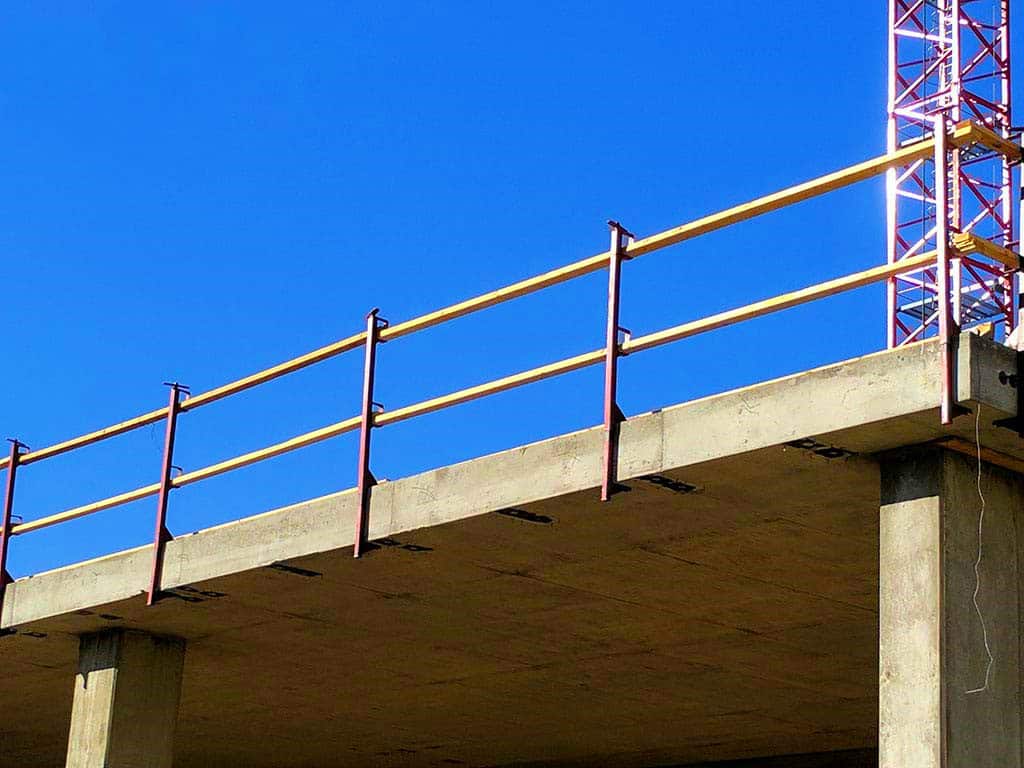
Two terms often used in this context are temporary edge protection and guardrails. People sometimes use them to mean the same thing, but there is a difference. A guardrail usually refers to a basic barrier with posts and rails, while temporary edge protection is a broader system that can include guardrails, mesh panels, toe boards, and different fixing methods. Understanding this difference helps contractors choose the right solution, avoid buying the wrong product, and improve both safety and efficiency on site.
What Is Temporary Edge Protection?
Temporary edge protection is a collective safety system designed to prevent workers and materials from falling from open or exposed edges during construction, maintenance, or temporary work. It is installed for a limited period while the permanent structure is still incomplete or while temporary access to hazardous areas is necessary.
The word temporary is important here. This system is not intended to remain as a permanent part of the finished building. Instead, it serves as a protective barrier during active project phases, such as structural frame erection, slab pouring, facade installation, roofing, or maintenance work.
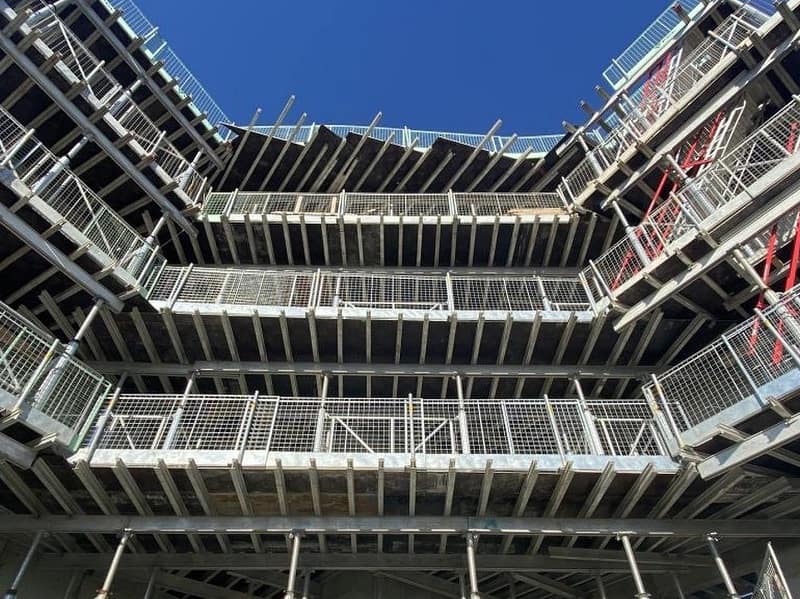
The term edge protection is also broader than many people realize. It does not only describe a horizontal rail fixed to posts. A true temporary edge protection system may include a combination of rails, mesh panels, toe boards, brackets, anchors, clamps, and special connectors. These elements work together to create a safer perimeter or barrier around openings and elevated work zones.
The purpose of temporary edge protection
The main purpose of temporary edge protection is to reduce fall hazards at exposed edges before permanent walls, parapets, balustrades, or facade systems are installed.
This type of protection is especially valuable because it provides collective protection, meaning multiple workers are protected at the same time without each individual needing to rely only on personal fall arrest equipment. In many construction safety strategies, collective protection is preferred because it reduces the chance of human error and offers more consistent site-wide protection.
In practical terms, temporary edge protection helps to:
- prevent workers from falling from elevated edges
- reduce the risk of tools or materials dropping onto lower levels
- define safe work zones near dangerous openings
- improve confidence and movement efficiency for workers at height
- support compliance with site safety requirements and project specifications
Typical components of a temporary edge protection system
A temporary edge protection system may include several parts depending on the application.
- Posts are vertical members that support the barrier.
- Mesh panels offer a more enclosed barrier and are often used where better coverage is required.
- Clamps, sockets, or brackets connect the system to concrete slabs, parapets, steel beams, or other structural elements.
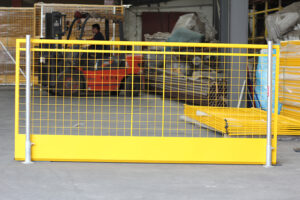
The actual system design depends on the structure being protected. For example, slab edge protection may use edge clamps or cast-in anchors, while roof edge protection may rely on parapet brackets or specially designed supports.
Where temporary edge protection is commonly used
Temporary edge protection is widely used across many sectors of construction because open edges are common on active jobsites.
Typical applications include:
- concrete slab perimeters on multi-story buildings
- roof edges during roofing or maintenance work
- stairwell openings before stair installation is complete
- lift shafts and service voids
- balcony edges during structural works
- bridge decks and infrastructure projects
- precast concrete assembly zones
- industrial platforms and temporary access areas
In each of these applications, the purpose is the same: create a physical barrier that prevents falls while allowing work to continue efficiently.
Why contractors use temporary edge protection
Contractors choose temporary edge protection because it is often safer, more efficient, and more adaptable than relying only on personal protective equipment.
A good temporary edge protection system can be:
- reused across multiple projects
- adjusted for different edge types
- installed quickly by trained crews
- integrated into repetitive site workflows
- transported and stored efficiently
For companies handling high-rise structures, concrete formwork cycles, or infrastructure jobs, this makes temporary edge protection not just a safety measure, but also a practical operational tool.
What Are Guardrails in Construction?
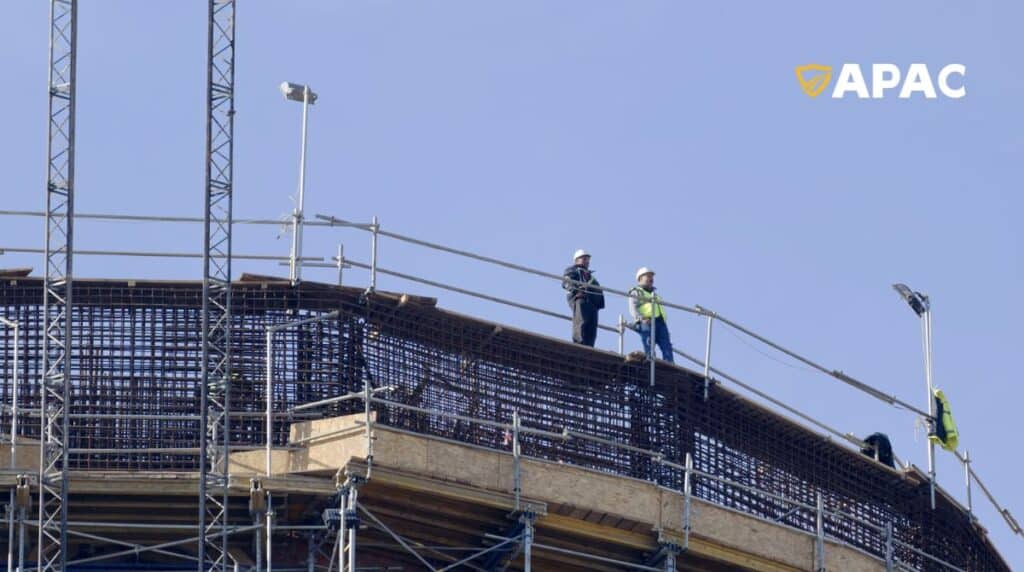
Guardrails are physical barrier systems installed to prevent people from falling from elevated surfaces or into dangerous openings. In construction, a guardrail is usually one of the most familiar and straightforward forms of fall prevention.
Guardrails can be temporary or permanent
One reason the term guardrail can be confusing is that it does not automatically mean temporary.
Some guardrails are permanent, such as those found on industrial platforms, building rooftops, walkways, and maintenance access areas. These are intended to remain in place for the life of the structure.
Others are temporary guardrails, installed during active construction or maintenance work. These are removed when the risk no longer exists or when permanent safety features are completed.
So when people say “guardrail,” they may be referring to a basic barrier design, not necessarily to a full temporary edge protection solution.
The main function of guardrails
Guardrails are primarily used to create a simple, direct barrier that stops workers from stepping or falling into hazardous zones.
They are widely used because they are:
- easy to understand
- visually clear on site
- effective in many standard situations
- relatively fast to install
- suitable for straightforward edge conditions
In many projects, a basic temporary guardrail is all that is required. For example, a working platform, short access route, or standard roof perimeter may only need a rail-based barrier rather than a more advanced protective system.
Common applications of guardrails
Guardrails are often used in:
- scaffolding platforms
- access walkways
- temporary working decks
- roof perimeters
- slab edges
- mezzanine levels
- equipment platforms
- maintenance zones
Because they are so common, many site teams use the word “guardrail” as a general label for any barrier that protects an edge. This is one reason why the distinction from temporary edge protection becomes blurred.
Why guardrails remain popular
Guardrails remain one of the most popular safety solutions because they combine simplicity with effectiveness.
For many contractors, guardrails offer practical advantages:
- low complexity
- quick visual identification
- simple installation logic
- easy training for site crews
- good suitability for standard linear edges
However, while guardrails are effective, they are not always the best solution for every site condition. More complex projects may require a broader temporary edge protection system with more specialized components and more complete coverage.
Temporary Edge Protection vs Guardrails: The Main Difference
The most important difference between temporary edge protection and guardrails is that guardrails usually describe a barrier type, while temporary edge protection describes a broader safety system.
This is the clearest way to understand the distinction.
A guardrail is often a specific arrangement of posts and horizontal rails that creates a physical barrier.
A temporary edge protection system may include guardrails, but it can also include mesh panels, toe boards, specialized brackets, anchors, adjustable supports, and other engineered parts tailored to a project’s needs.
Guardrails are often one part of the bigger system
In many real-world projects, the visible rail section is only one part of the overall edge protection arrangement. The full system may also require:
- fixing devices for concrete or steel
- mesh infill for better coverage
- toe boards for falling object protection
- adjustable posts for varying edge geometry
- modular components for repeated installation and removal
So while the barrier may look like a “guardrail,” the complete solution is actually temporary edge protection.
Temporary edge protection focuses more on the whole application
The phrase temporary edge protection tends to focus on the complete site solution, not just the visible rail.
That means it considers:
- the type of structure being protected
- how the system is attached
- how much coverage is needed
- whether the edge is regular or irregular
- whether falling object control is necessary
- how long the protection will stay in place
- how often the system will be reused
This makes temporary edge protection a more technical and application-based term.
Why These Terms Are Often Used Interchangeably
Although there is a technical difference, many people still use these terms in the same way. That is understandable, because in daily construction practice the visual difference is not always obvious.
The rail is the most visible part
On most sites, the first thing workers see is the top rail and mid rail. They do not usually refer to the clamps, anchors, brackets, or connectors when talking about the system. As a result, the whole arrangement gets called a guardrail.
Different countries and companies use different wording
Construction terminology is not always standardized in everyday business communication. One supplier may use:
- temporary edge protection system
Another may say:
- temporary guardrail system
Another may say:
- perimeter safety barrier
All of these may describe similar products, but with slight differences in design or scope.
Some systems really do overlap heavily
In simple applications, a temporary edge protection system may look almost identical to a basic guardrail. For example, a line of posts with top and mid rails along a slab edge may be described accurately by either term, depending on context.
That overlap is why confusion happens so easily.
Site language is often less technical than engineering language
On site, speed matters. Workers and supervisors often use whatever term is shortest and most familiar. But in purchasing, engineering, and export sales, precision matters more. A small wording difference can affect product selection, shipping quantities, and compatibility with the structure.
Detailed Differences in Design, Function, and Use
Even though the two concepts overlap, there are several practical differences between temporary edge protection and standard guardrails.
1. Difference in scope
A guardrail is usually a single barrier style.
Temporary edge protection is a project-oriented protective system.
This means edge protection typically includes not just the barrier line itself, but also the support method, installation configuration, and coverage level needed for the actual hazard.
2. Difference in adaptability
Guardrails are often suitable for standard layouts and straightforward edge lines.
Temporary edge protection tends to be more adaptable to changing or complex site conditions.
For example, temporary edge protection may be better suited for:
- irregular slab edges
- stair cores
- void openings
- curved edges
- varying floor heights
- changing formwork cycles
This adaptability is especially valuable on large building projects where each floor repeats but still has structural variations.
3. Difference in attachment methods
Basic guardrails may use simple surface fixing or post mounting.
Temporary edge protection systems often include specialized attachment methods such as:
- slab clamps
- cast-in sockets
- side-mount brackets
- parapet clamps
- steel beam connectors
These fixing methods are important because the barrier is only as effective as the way it is attached to the structure.
4. Difference in level of enclosure
A basic guardrail creates a line barrier.
Temporary edge protection may provide a higher level of enclosure, especially when it includes mesh panels or enclosed barrier units.
This can be useful where:
- there is a higher risk of falling tools
- the opening is large or irregular
- workers need more visual separation from the edge
- public or lower-level activity requires better object containment
5. Difference in project planning value
Guardrails are often chosen for immediate and simple protection needs.
Temporary edge protection is often part of a larger site safety and workflow strategy.
On repetitive projects, such as multi-floor concrete structures, edge protection systems can be selected based on:
- cycle efficiency
- storage and transport
- repeated installation speed
- maintenance and durability
- compatibility with formwork or scaffolding operations
This makes temporary edge protection more significant from an operational planning standpoint.
Are Guardrails a Type of Temporary Edge Protection?
In many cases, yes. A guardrail can be considered one type of temporary edge protection, or one visible component of a larger temporary edge protection system.
That is the most practical answer.
If a contractor installs posts and horizontal rails around a slab perimeter for a limited time, that setup may reasonably be described as both:
- a temporary guardrail
- a temporary edge protection system
The difference becomes more noticeable when the project requires extra components or a more engineered approach.
For example:
- A simple roof rail setup may be called a temporary guardrail.
- A modular system with posts, mesh panels, toe boards, and slab clamps is more accurately described as temporary edge protection.
So the question is not whether guardrails and edge protection are completely separate. Instead, it is whether the project requires only a basic barrier or a broader, more adaptable system.
When Temporary Edge Protection Is the Better Choice
Temporary edge protection is generally the better option when a site has more demanding fall hazards or when the project requires a system tailored to specific structural conditions.
Slab edge construction
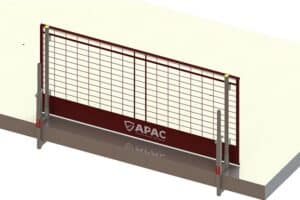
Slab edges are one of the most common applications for temporary edge protection. In concrete frame construction, each floor perimeter presents an ongoing fall risk until permanent facade or wall systems are in place.
A dedicated edge protection system is often better here because it can:
- attach securely to slab edges
- support repeated floor-to-floor use
- adapt to changing pour cycles
- provide consistent perimeter safety
For multi-story projects, this type of repeatability is a major advantage.
Roof edges
Roof work is another area where temporary edge protection often performs better than a very basic rail setup. Roof structures vary greatly. Some have parapets, some do not, and some require temporary access for maintenance, waterproofing, mechanical installation, or facade works.
A more complete edge protection solution can better match these conditions, especially if roof geometry is not simple.
Stairwells and lift shafts
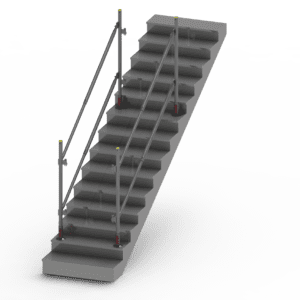
These openings present different hazards from a straight perimeter edge. A simple rail may not always provide sufficient closure or visual control. Systems with mesh panels or more complete opening protection are often more suitable.
Bridge and infrastructure projects
Infrastructure edges are often exposed to weather, vibration, irregular geometry, and non-standard supports. Temporary edge protection designed for these conditions can provide better safety and easier installation than a generic guardrail product.
High-rise and repetitive construction cycles
When contractors install and remove protection repeatedly across many levels, modular temporary edge protection offers strong long-term value. It improves consistency, saves labor over time, and simplifies logistics across multiple construction phases.
When Standard Guardrails Are Enough
Standard guardrails are still a very practical solution in the right circumstances. Not every application requires a complex or highly engineered system.
A standard guardrail may be enough when:
- the edge is straight and easy to access
- the fixing method is simple
- the work is short-term
- the geometry is standard
- the hazard is clearly defined and limited
- no additional enclosure is necessary
Examples of suitable situations
Good examples include:
- temporary access platforms
- scaffold working levels
- short-duration maintenance areas
- simple roof edges
- internal platform perimeters
- controlled walkways
In these situations, the benefits of standard guardrails are clear.
Benefits of standard guardrails
They are often:
- faster to understand and deploy
- easier to inspect visually
- cost-effective for basic tasks
- less complex to store and transport
- suitable for routine fall prevention needs
For many contractors, standard guardrails are the right balance of safety, simplicity, and cost when the application is not demanding.
How to Choose the Right System for Your Project
Choosing between temporary edge protection and standard guardrails should never be based only on familiar terminology. The better approach is to assess the real site conditions and the level of protection required.
1. Identify the hazard type
First, determine what exactly needs protection:
- open slab edge
- roof perimeter
- stair opening
- shaft opening
- platform edge
- bridge deck edge
Each hazard may require a different type of solution.
2. Assess the supporting structure
The barrier must be compatible with the structure it will attach to. Concrete slabs, parapets, steel beams, precast units, and temporary platforms all require different fixing strategies.
3. Consider the complexity of the edge
Straight edges with standard dimensions are usually easier to protect. Irregular or changing geometries may require a more flexible temporary edge protection system.
4. Think about duration of use
A short-term maintenance task may only need simple guardrails. A long-duration building project with repeated edge exposure may justify investing in a reusable modular system.
5. Determine the needed level of coverage
If there is concern about dropped tools, open voids, or more complete separation from the edge, a mesh-based or more enclosed edge protection solution may be more suitable than a simple rail.
6. Evaluate reusability and long-term cost
The initial purchase price is only one part of the real cost. Contractors should also consider:
- expected service life
- corrosion resistance
- maintenance needs
- labor savings during installation
- transport and storage efficiency
- suitability for future projects
7. Review supplier capability
A good supplier should help with more than product availability. They should also support the buyer with:
- technical understanding of the application
- product matching for structure type
- customization options if needed
- consistent quality
- export and delivery reliability
For B2B buyers, this technical support can be just as important as the product itself.
Conclusion
Temporary edge protection and guardrails are closely related, but they are not exactly the same.
A guardrail usually refers to a rail-based barrier system made of posts, top rails, and mid rails. It is one of the most common and effective forms of fall prevention on construction sites.
Temporary edge protection is a broader term. It refers to the full temporary safety solution used to protect workers from open edges during construction or maintenance. It may include guardrails, but it can also include mesh panels, toe boards, brackets, clamps, anchors, and other site-specific components.
In simple situations, a standard guardrail may be completely sufficient. In more demanding projects, such as slab edge construction, roofing, stairwells, lift shafts, bridge work, and repetitive high-rise cycles, a broader temporary edge protection system is often the better choice.
For contractors, buyers, and distributors, the key is to focus on the actual application rather than the label alone. The right solution should match the edge type, structure, fixing method, duration of use, and required level of protection.
When selected correctly, both guardrails and temporary edge protection systems can improve worker safety, reduce risk, and support more efficient project execution.