

Introduction
The safety of construction workers at height has always been a top priority, but recent updates to European standards reflect an even stronger commitment to fall prevention. BS EN 13374:2025 is the latest revision of the harmonized European standard for temporary edge protection systems (TEPS), superseding the previous 2013+A1:2018 version. This revision not only enhances technical definitions and performance criteria but also aligns edge protection systems with the realities of modern construction sites.
For manufacturers, contractors, and international buyers — particularly across the EU, UK, Italy, France, Germany, and Switzerland — understanding and adopting this revised standard is essential for compliance, safety assurance, and commercial competitiveness.
What is BS EN 13374:2025?
BS EN 13374:2025 is a harmonized technical standard developed by CEN (European Committee for Standardization) for temporary edge protection systems used during construction. It covers systems designed to prevent workers and materials from falling off unprotected edges, such as slabs, roof surfaces, and formwork platforms.
Published in May 2025, this edition replaces the previous 2013+A1:2018 version and introduces several critical updates that reflect the evolving demands of worksite safety, product certification, and international conformity. For more details, you can read <What is BS EN 13374 – and What It Means to Edge Protection>.
Key Changes in the 2025 Edition
Redefined Class Criteria (A, B, C)
- Class A: Still for static load protection (e.g., leaning or resting forces), but with clearer usage scenarios.
- Class B: Updated to reflect moderate dynamic risk conditions. New drop test energy of 1100J.
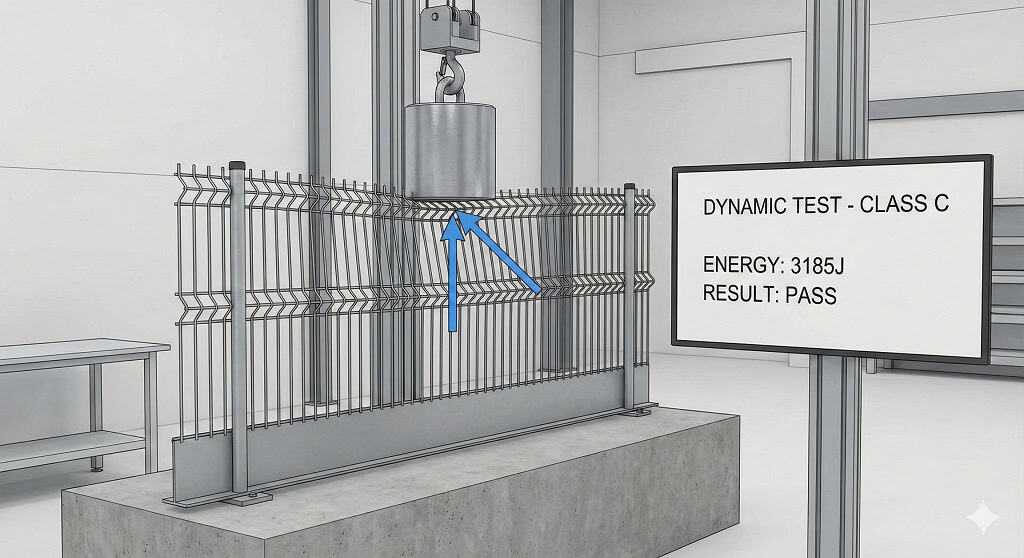
- Class C: Full fall arrest protection, now requiring systems to absorb 3185J of dynamic impact.
- Annex A now provides slope-based diagrams to help users correctly choose the appropriate class.
Revised Testing Protocols
- More stringent dynamic load tests simulate real-world impacts (e.g., falling tools, people).
- Systems must now prove performance under multi-component conditions, not isolated part testing.
- Drop mass weight and height parameters are updated to align with latest safety data.
Documentation and Traceability
- CE/UKCA markings must now explicitly reference BS EN 13374:2025.
- Annex B offers simplified conformity guidelines for small manufacturers.
- Records of test results, material specs, and configuration drawings must be retained for inspection.
Structural Load Design Updates
- The standard incorporates Eurocode design methods (EN 1990, EN 1991, EN 1993).
- Guidance is provided for calculating wind loads, deformation, and material resistance.
Greater Harmonization
- Alignment with related international standards: ISO 14122 and AS/NZS 4994.1.
Enhanced compatibility for products exported or used across borders within Europe and beyond.
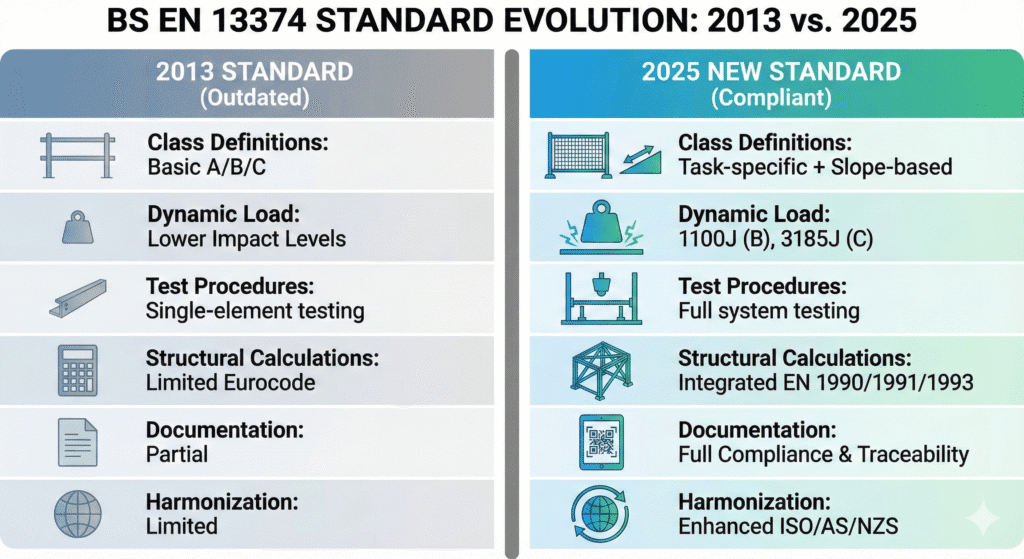
BS EN 13374:2025 vs. BS EN 13374:2013+A1:2018 (Comparison Table)
Feature | 2013+A1:2018 Version | 2025 Revision |
Class Definitions | Basic A/B/C descriptions | Task-specific + slope-based illustrations |
Dynamic Load Thresholds | Lower impact levels | 1100J (B), 3185J (C) |
Test Procedures | Single-element testing allowed | Full system testing under real conditions |
Structural Calculations | Eurocode references limited | Integrated EN 1990/1991/1993 design rules |
Documentation Requirements | Partial for some components | Full compliance and traceability required |
Harmonization with Other Standards | Limited | Enhanced ISO/AS/NZS alignment |
For more detailed technical differences, see: BS EN 13374:2025 vs BS EN 13374:2013 – What Has Changed.
Why This Matters for EU, UK, and DACH Region Buyers and Builders
- Regulatory Enforcement: Countries such as Germany, France, and Italy increasingly require proof of current compliance with the latest safety standards, especially for public works and critical infrastructure. BS EN 13374:2025 compliance is often a prerequisite in national procurement guidelines.
- Tendering and Prequalification: Many project owners and general contractors across the EU and UK now mandate edge protection systems tested under the latest version. Contractors using outdated documentation or certifications may be disqualified during prequalification or procurement reviews.
- Insurance and Liability Exposure: Updated standards are closely tied to insurance eligibility. Insurers across Europe expect use of 2025-compliant systems to mitigate claim risks. Non-conforming installations may be flagged during audits, raising potential for fines or rejected claims after incidents.
- Trade and Cross-Border Sales: The 2025 revision supports streamlined export processes between the UK, Switzerland, and EU nations due to clearer documentation and product classification. This benefits manufacturers seeking CE/UKCA market access and buyers demanding proof of harmonized safety credentials.
- Worker Safety and Market Reputation: Builders and contractors that invest in certified edge protection systems reduce injury rates and show visible commitment to compliance. This not only protects workers but enhances brand reputation with regulators, inspectors, and clients. Builders who invest in up-to-date safety systems demonstrate a strong commitment to worker welfare and regulatory accountability. This can enhance relationships with project stakeholders, inspectors, and end clients, strengthening competitive positioning in safety-conscious markets.
What Manufacturers and Contractors Need to Do
Manufacturers and contractors must begin by re-testing their existing edge protection systems under the updated dynamic and structural load requirements introduced in BS EN 13374:2025. This includes verifying that products meet the new impact energy thresholds, particularly for Classes B and C, and ensuring that full-system testing, rather than isolated component testing, has been conducted.
In addition to physical re-testing, all technical documentation must be revised to reflect the 2025 version. This involves updating CE/UKCA declarations, preparing comprehensive test certificates, and ensuring that traceability data such as material specifications, assembly drawings, and conformity assessment reports are organized and accessible.
Training of internal staff is equally important. Teams responsible for production, quality control, and technical support must be familiar with the revised requirements. Distributors and sales agents also need guidance so they can accurately communicate compliance details to customers and project managers.
Finally, it is critical to collaborate with notified bodies and accredited testing laboratories that are experienced with the EN 13374:2025 testing regime. These organizations will provide certification support, validate system performance, and help ensure that all conformity procedures meet EU and UK regulatory expectations.

Conclusion
BS EN 13374:2025 reflects a modernized and more robust approach to regulating temporary edge protection systems across Europe. It incorporates enhanced safety requirements, clearer classifications based on use-case scenarios, and introduces higher dynamic impact thresholds to better simulate real-world jobsite risks.
One of the most significant aspects of this update is its emphasis on documentation and traceability. By enforcing full compliance across testing, materials, and structural design, the standard strengthens legal defensibility, improves procurement transparency, and ensures products meet consistent quality expectations across borders.
For stakeholders in manufacturing, construction, and procurement, aligning with the 2025 standard is no longer optional—it is an operational necessity to ensure market relevance, regulatory compliance, and end-user safety in projects throughout the EU, UK, and broader international markets.
 EN
EN  SV
SV  IT
IT  FR
FR  ES
ES  AR
AR  DE
DE  FI
FI  LV
LV  ET
ET