
Introduction
Choosing an edge protection system is not just about buying barriers, posts, or guardrails.
For contractors, rental companies, safety distributors, and procurement teams, the real question is:
Which edge protection system fits the actual project condition?
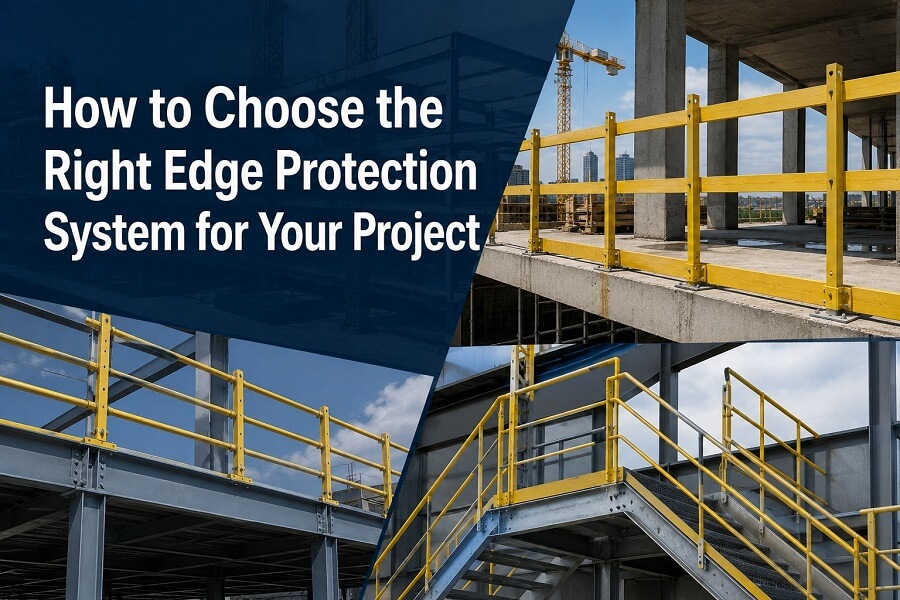
A concrete slab edge, steel beam, staircase, formwork platform, excavation area, and roof edge may all need fall protection. But they do not always use the same fixing method, component layout, installation process, or load consideration.
If the wrong system is selected, the result can be more than a small inconvenience. It may cause installation delays, unsuitable components, additional modification work, compliance concerns, or higher overall project cost.
This guide explains how to choose the right edge protection system for your project before placing an order.

1. Start with the Structure Type
The first step is to identify the structure where the edge protection system will be installed.
Many buyers simply ask for “temporary edge protection,” but suppliers need to understand the actual site condition before recommending a suitable solution.
Common structure types include:
- Concrete slab edges
- Steel beams
- Stair openings
- Formwork structures
- Excavation or trench edges
- Roof edges
- Voids, shafts, and openings
- Bridge or infrastructure edges
Each structure requires a different approach.
For example, a concrete slab may use slab grabs, bolt-down posts, or edge brackets. A steel structure may require beam clamps. A stair opening may need a system designed for inclined or stepped areas. Excavation protection may require different clamps or guardrail arrangements depending on the ground condition and temporary works design.
Selection tip:
Before asking for a quotation, prepare basic information about the structure type. This helps the supplier recommend the correct fixing method and avoid mismatched components.
2. Choose the Right Fixing Method
The fixing method is one of the most important factors in edge protection selection.
A system may look simple from the outside, but how it connects to the structure determines whether it can be installed efficiently and safely on site.
Common fixing methods include:
Bolt-Down Edge Protection
Bolt-down systems are fixed directly to the concrete surface with anchors or bolts. They are often used where a strong mechanical connection is required.
They are suitable for many concrete applications, but they require drilling and site preparation.

Slab Grab Edge Protection
Slab grab systems clamp onto the slab edge without drilling. They are often used when the project wants to reduce drilling work or when fast installation is important.
This type of system is useful for concrete slab edge protection, especially where flexibility and repeated use are needed.
Beam Clamp Edge Protection
Beam clamp systems are commonly used for steel structures. They connect to steel beams without welding or drilling into the main structure.
This can be useful for warehouse projects, industrial buildings, steel frames, and infrastructure works.
Compression Post Edge Protection
Compression post systems are installed between floor and ceiling surfaces using pressure. They are often used for temporary guardrail or mesh barrier applications where the structure allows vertical compression fixing.
Guardrail and Barrier Systems
Some projects may use modular guardrail systems, mesh barriers, walkway barriers, or full-height panels depending on the risk level and project requirement.
Selection tip:
Do not choose the fixing method only by price. The wrong fixing method may increase labor time, require additional drilling, or fail to match the actual site condition.
3. Consider the Project Stage
Edge protection requirements may change at different stages of construction.
A project may need one type of system during structural works and another type during façade, stair, roof, or finishing stages.
For example:
- During concrete frame construction, slab edge protection may be needed.
- During steel frame erection, beam clamp protection may be more suitable.
- During stair construction, stair edge protection may be required.
- During excavation, trench or sheet pile edge protection may be needed.
- During roof or maintenance work, guardrail or roof edge protection may be selected.
The best edge protection system is not always a single product. It may be a group of compatible components used across different phases of the project.
Selection tip:
If your project has multiple stages, ask whether the system components can be reused or reconfigured. A modular system may reduce repeated purchasing and simplify inventory management.
4. Check the Required Standard and Compliance Documents
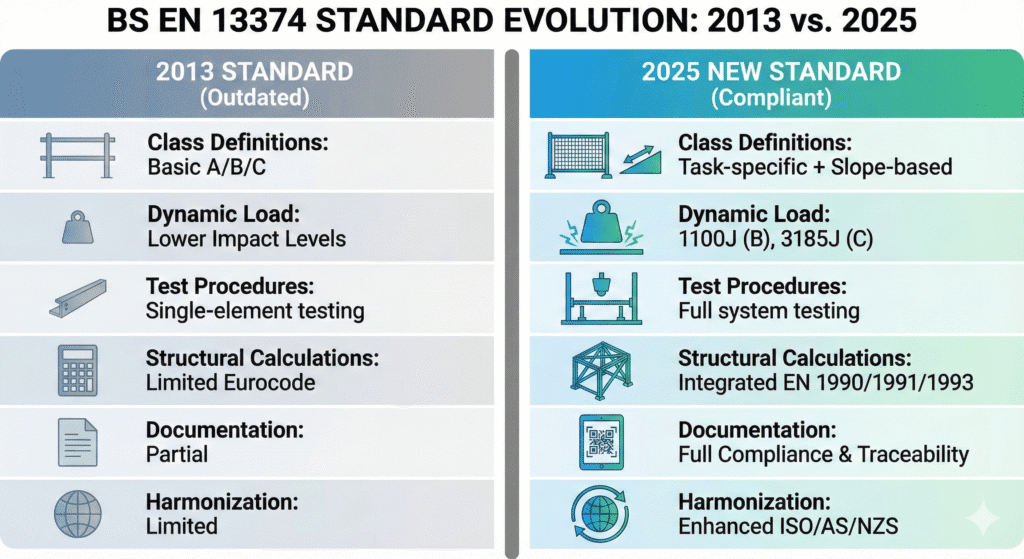
For many markets, edge protection is not only a site safety product. It is also part of compliance and project documentation.
In Europe and the UK, EN 13374 is commonly used for temporary edge protection systems. It specifies requirements and test methods for systems used during construction or maintenance, including applications on flat and inclined surfaces.
When choosing a supplier, buyers should check whether the supplier can provide relevant documentation, such as:
- Test reports
- Product specifications
- Material information
- Installation guidance
- Drawings or layout support
- Surface treatment details
- Packaging and loading information
For contractors and distributors, these documents are important because they help with project approval, safety review, internal procurement checks, and customer communication.
Selection tip:
Do not only ask whether a product is “compliant.” Ask what documents the supplier can provide to support the claim.
5. Match the System to the Site Layout
Even if the product itself is suitable, the site layout may still create challenges.
Before selecting an edge protection system, consider:
- Edge length
- Slab thickness
- Beam size
- Opening size
- Stair angle
- Floor-to-ceiling height
- Access points
- Corner areas
- Obstructions
- Installation sequence
A good supplier should not only sell standard parts. They should also help review the project layout and suggest a practical configuration.
For example, a long straight slab edge may be simple to protect. But a project with corners, openings, stairs, and irregular edges may need different post bases, panel sizes, clamps, or connectors.
Selection tip:
If possible, send drawings, photos, or a simple sketch to the supplier. This makes the quotation more accurate and reduces the risk of missing components.
6. Think About Installation Speed
Installation speed has a direct impact on site productivity.
A low-cost system may not be truly cost-effective if it requires too much labor, drilling, adjustment, or rework.
When comparing systems, ask:
- How many workers are needed for installation?
- Are special tools required?
- Is drilling required?
- Can the system be adjusted on site?
- Are components easy to identify?
- Can the system be reused on another project?
- Is there an installation guide or video?
For large projects, small installation delays can become expensive when repeated across many floors or work areas.
Selection tip:
Do not compare only unit price. Compare the total cost of product, installation labor, rework risk, and reuse value.
7. Evaluate Component Compatibility
A strong edge protection system should be easy to combine, adjust, and reuse.
This is especially important for rental companies, distributors, and contractors who manage multiple projects.
A modular system can help reduce inventory complexity because the same panels, posts, brackets, or clamps may be used in different applications.
APAC presents edge protection solutions across multiple site conditions, including concrete structures, steel structures, stairs, formwork, excavation, between slabs, and guardrail applications. APAC also states that it offers over 200 compatible parts for customized edge protection systems.
This type of compatibility is valuable for buyers who want one supplier to support different project types.
Selection tip:
Ask whether the system components are compatible with each other. This can help reduce future purchasing cost and improve stock management.
8. Review Material, Surface Treatment, and Durability
Edge protection systems are used in demanding construction environments.
Products may be exposed to impact, weather, repeated handling, concrete dust, site storage, transport, and installation cycles.
When reviewing product quality, pay attention to:
- Steel grade or material specification
- Welding quality
- Mesh panel strength
- Post thickness
- Clamp structure
- Surface treatment
- Corrosion resistance
- Packaging method
Hot-dip galvanizing, powder coating, or other surface treatments may be selected depending on project environment, budget, and expected reuse cycles.
Selection tip:
For rental and repeated-use projects, durability may be more important than the lowest initial purchase price.
9. Consider Packaging and Logistics
For international buyers, packaging and container loading are also part of the purchasing decision.
A good edge protection supplier should consider:
- Pallet design
- Component protection during transport
- Loading quantity
- Container optimization
- Easy unloading
- Clear product labeling
- Reduced damage risk
This is especially important for mesh barriers, long posts, brackets, clamps, and accessories. Poor packaging can lead to bent panels, scratched surfaces, missing parts, or extra sorting work after arrival.
Selection tip:
Ask the supplier for packing photos, loading plans, or previous shipment examples before confirming the order.
10. Choose a Supplier Who Can Support Project Selection
The right edge protection supplier should not only quote a price list.
They should be able to help you answer questions such as:
- Which system fits my structure?
- Which fixing method is suitable?
- What components are required?
- Can the system be adjusted for my project?
- What documents are available?
- How should the products be packed?
- Can the system be reused on future projects?
For B2B buyers, this support can reduce risk before the order is placed.
If a supplier does not ask about your structure type, drawing, project stage, or standard requirement, the quotation may not be accurate enough.
Selection tip:
A professional supplier should help you select the right system before discussing final price.
Edge Protection System Selection Checklist
Before requesting a quotation, prepare the following information:
| Item | Why It Matters |
| Project type | Helps identify the general application |
| Structure type | Determines fixing method |
| Drawing or photo | Helps confirm layout and quantity |
| Edge length | Helps estimate panels, posts, and accessories |
| Slab thickness or beam size | Helps confirm clamp or base compatibility |
| Required standard | Helps confirm compliance documents |
| Installation stage | Helps select suitable components |
| Destination country | Helps plan packaging, documents, and delivery |
| Quantity estimate | Helps calculate production and shipping cost |
| Special site condition | Helps avoid unsuitable systems |
The more information you provide, the more accurate the recommendation and quotation will be.
Common Mistakes When Choosing Edge Protection Systems
Mistake 1: Choosing Only by Price
The cheapest system may create extra cost if it does not fit the project, requires modification, or causes installation delays.
Mistake 2: Ignoring the Fixing Method
A barrier panel is only useful when it can be fixed correctly to the structure.
Mistake 3: Not Checking Compatibility
If components cannot work together, buyers may need to purchase additional parts later.
Mistake 4: Not Asking for Documents
Test reports, specifications, drawings, and installation guidance are important for serious projects.
Mistake 5: Ordering Without Drawings or Site Information
Without project details, the supplier may only provide a general quotation, not a project-specific solution.
Conclusion
Choosing the right edge protection system starts with understanding the project condition.
A concrete slab, steel beam, staircase, formwork platform, excavation area, and roof edge may all require different solutions. The right system should match the structure type, fixing method, site layout, installation stage, compliance requirement, and reuse plan.
For contractors, distributors, and procurement teams, this approach helps reduce wrong component selection, installation delays, compliance risks, and unnecessary cost.
At APAC, we provide edge protection system solutions for different construction site applications, including concrete structures, steel structures, stair protection, formwork protection, excavation protection, guardrail systems, compression post systems, and more.
If you are not sure which system fits your project, send us your drawing, structure type, or site condition. Our team can help review your application and recommend a practical edge protection solution.
Recommended internal link:
Explore APAC Edge Protection System Solutions
FAQ
1. What is an edge protection system?
An edge protection system is a temporary safety system used to help prevent workers, tools, or materials from falling from exposed edges during construction or maintenance work. It usually includes posts, barriers, guardrails, clamps, brackets, or other fixing components.
2. How do I choose the right edge protection system?
Start by checking the structure type, fixing method, project stage, site layout, required standard, and installation condition. If you are unsure, send your drawing or site photo to the supplier for review.
3. What is the difference between slab grab and bolt-down edge protection?
A slab grab system clamps onto the slab edge, while a bolt-down system is fixed to the concrete surface with anchors or bolts. The right choice depends on the slab condition, installation requirement, drilling allowance, and project preference.
4. Can one edge protection system be used for different projects?
Yes, modular edge protection systems can often be reused or reconfigured across different projects. However, the fixing method and components must match each site condition.
5. What information should I provide for an edge protection quotation?
You should provide the project type, structure type, drawings or photos, edge length, slab thickness or beam size, required standard, destination country, and expected quantity. This helps the supplier recommend the right system and prepare a more accurate quotation.
 EN
EN  SV
SV  IT
IT  FR
FR  ES
ES  AR
AR  DE
DE  FI
FI  LV
LV  ET
ET