

Introduction
Edge protection is used on construction sites to help prevent workers, tools, and materials from falling from open edges. It is commonly installed around slabs, roofs, stairs, formwork areas, excavations, and other exposed work zones.
Different site conditions require different edge protection systems. For example, a concrete slab, steel beam, stairway, formwork platform, trench edge, or roof area may all need different fixing methods.
In this guide, we will look at the main types of edge protection systems and how they are used in different construction applications.
Quick Comparison of Edge Protection Types
Type of Edge Protection | Fixed To | Common Fixing Method | Typical Application |
Concrete Edge Protection Systems | Concrete slab edge | Bolt-down, slab grab, edge bracket | Slab edges, balconies, floor perimeters |
Steel Structure Edge Protection Systems | Steel beams | I-beam clamp, facade bracket | Steel structures, bridges, facade works |
Stair Edge Protection Systems | Stair structure | Clamp-on, socket base, mesh barrier | Stairways, landings, stair cores |
Formwork Edge Protection Systems | H20 beam / aluminium beam | Beam clamp | Formwork and concrete pouring stages |
Excavation Edge Protection Systems | Sheet pile / trench edge | Sheet pile clamp, trench guard | Trenches, pits, excavations |
Compression Post Edge Protection Systems | Between slabs | Compression fixing | No-drilling areas between floor slabs |
Guardrail and Roof Edge Protection Systems | Roof, parapet, platform | Base, grabber, parapet, roof guardrail | Roofs, parapets, maintenance areas |
Main Types of Edge Protection Systems
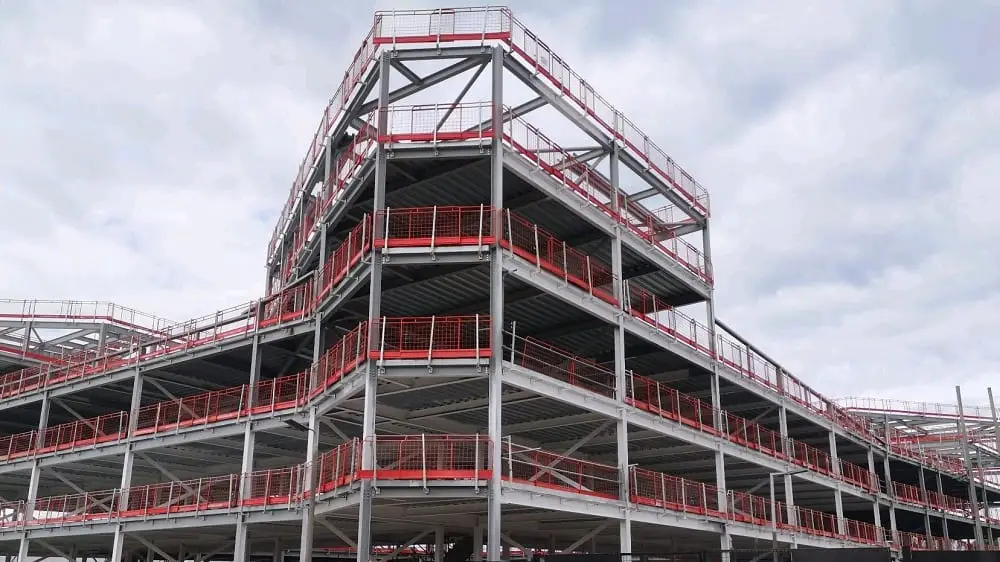
1. Concrete Edge Protection Systems
Concrete edge protection systems are among the most common types of temporary edge protection used in construction. They are designed for concrete slab edges, balconies, open floor perimeters, walkways, and other exposed concrete areas.
During concrete frame construction, each floor level may have multiple open edges. Without proper protection, these areas create serious fall hazards for workers and risks of falling tools or materials. Concrete edge protection systems provide a physical barrier around these exposed edges and help create a safer working area.
Common applications include:
- Concrete slab edges
- Balcony edges
- Floor perimeters
- Open slab areas
- Walkways
- Temporary openings
- High-rise concrete frame buildings
Concrete edge protection can be installed in several ways depending on the site condition. A bolt-down system is fixed directly to the concrete surface using anchors. A slab grab system clamps onto the slab edge without requiring the same type of surface fixing. Edge bracket systems are often used where the protection needs to be positioned outside or along the edge of the structure.
Typical concrete edge protection products include:
- Safedge Bolt Down Edge Protection System
- TG Bolt Down Edge Protection System
- Slab Grab Edge Protection System
- Edge Bracket Edge Protection System
- TG Edge Bracket Edge Protection System
- Walkway Barrier Edge Protection System
Concrete edge protection is suitable for residential buildings, commercial buildings, high-rise construction, and concrete frame projects. For contractors working across multiple floors, modular concrete edge protection systems can also help simplify installation, removal, and reuse from one level to another.
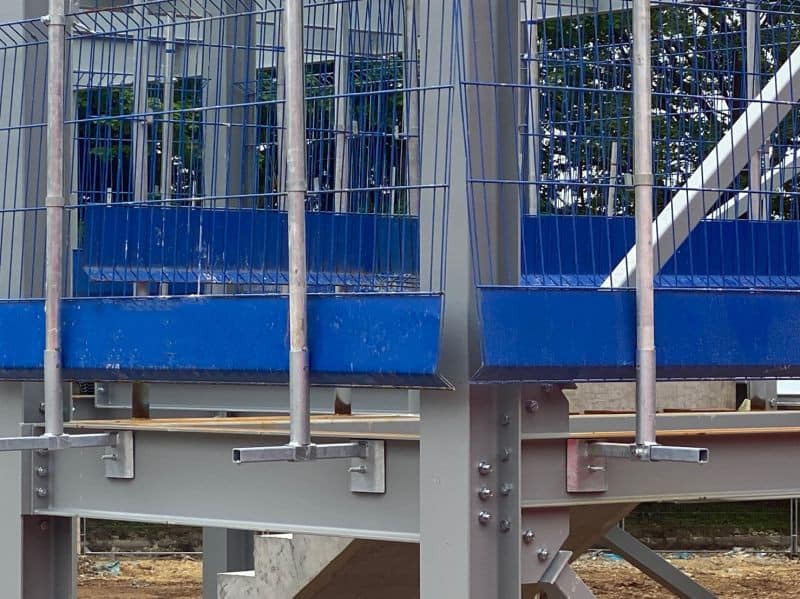
2. Steel Structure Edge Protection Systems
Steel structure edge protection systems are designed for projects where the main fixing point is a steel beam or steel frame instead of a concrete slab. These systems are commonly used during steel structure erection, bridge construction, industrial building work, and facade installation.
Unlike concrete edge protection, steel structure systems usually do not rely on anchors fixed into concrete. Instead, they use clamps or brackets that connect to steel beams or structural members. This makes them useful during early-stage construction when concrete floors may not yet be available.
Common applications include:
- Steel-frame buildings
- I-beams and structural steel members
- Bridge construction
- Facade installation
- Industrial steel structures
- Infrastructure projects
- Temporary steel working platforms
Typical steel structure edge protection products include:
- I-Beam Clamp Edge Protection System
- I-Beam Facade Bracket Edge Protection System
The main advantage of steel structure edge protection is that it is designed around the shape and behavior of steel structures. A clamp-on system can provide temporary edge protection without needing to modify the concrete structure. This is especially valuable for projects where workers are exposed to open edges during steel erection or facade works.
Steel edge protection is commonly used by steel contractors, bridge contractors, facade contractors, and industrial construction teams.
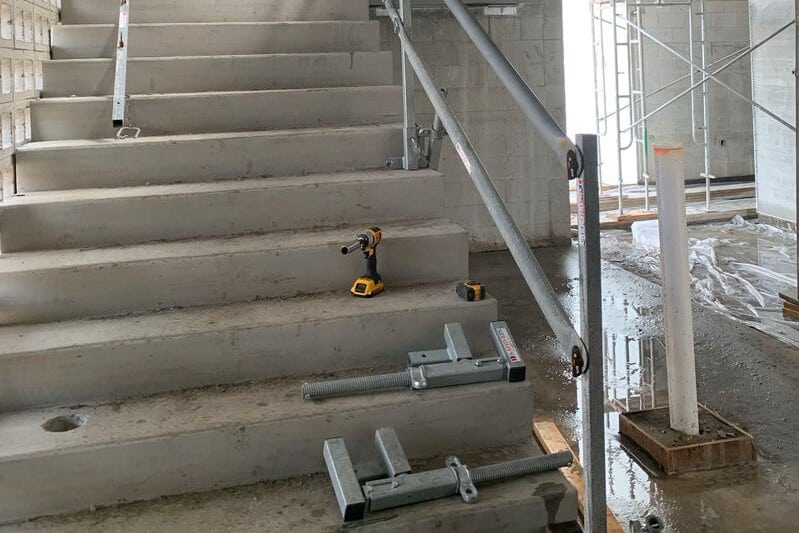
3. Stair Edge Protection Systems
Stair areas are high-risk zones on construction sites because workers frequently move between levels. Temporary stairways, stair cores, stair landings, and unfinished stair edges all require reliable protection during construction.
Stair edge protection systems are designed to protect workers as they move through these access routes. They can also help control movement around stair openings and reduce the risk of falls from landings or stair edges.
Common applications include:
- Stair flights
- Stair landings
- Stair cores
- Temporary stair access routes
- Multi-level construction areas
- Residential towers
- Commercial buildings
Typical stair edge protection products include:
- Clamp On Stair Edge Protection System
- Socket Base Stairway Edge Protection System
- Mesh Barrier Stair Edge Protection System
Different stair areas may require different fixing methods. Clamp-on stair systems are suitable when the system needs to attach to existing stair structures. Socket base systems may be used where posts can be installed into prepared bases. Mesh barrier stair systems provide a more complete barrier solution and are useful where both fall prevention and area separation are required.
Stair edge protection is especially important in high-rise buildings, apartment projects, commercial buildings, and projects with heavy worker movement between floors.
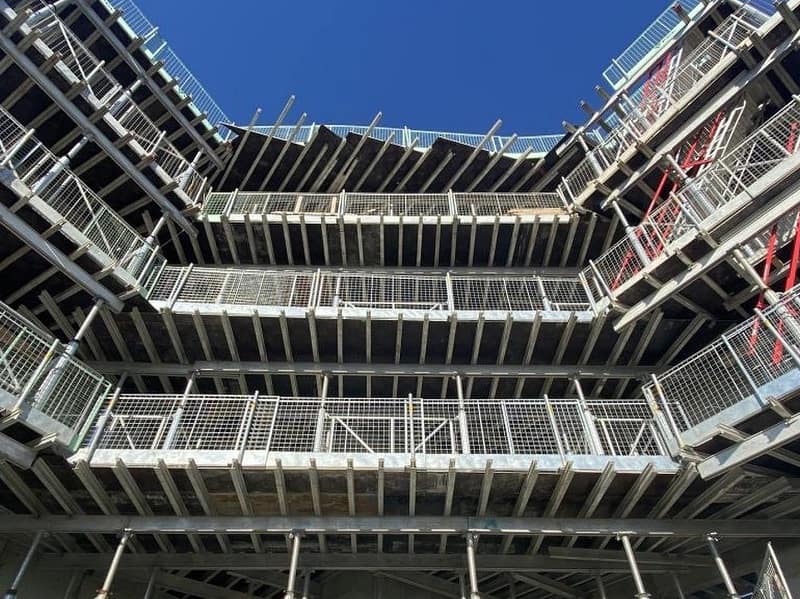
4. Formwork Edge Protection Systems
Formwork edge protection is used during concrete forming and pouring stages. Before the permanent structure is complete, workers may need to operate on temporary formwork platforms, H20 timber beams, aluminium beams, or formwork support systems. These areas can create exposed edges that require temporary fall protection.
Formwork edge protection systems are designed to attach to the formwork structure rather than the completed concrete slab. This makes them useful at an earlier stage of construction, before the finished floor or slab edge is ready.
Common applications include:
- H20 timber beam formwork
- Aluminium beam formwork
- Temporary formwork platforms
- Slab casting areas
- Concrete pouring stages
- Formwork support structures
Typical formwork edge protection products include:
- H20 Beam Clamp Edge Protection System
- Aluminium Beam Clamp Edge Protection System
The main purpose of formwork edge protection is to provide temporary protection during the active forming and pouring process. Because formwork systems are often assembled and dismantled quickly, the edge protection system should also be easy to install, remove, and relocate.
This type of system is suitable for formwork contractors, concrete contractors, slab construction projects, and temporary working platforms where permanent edge fixing is not yet available.

5. Excavation Edge Protection Systems
Excavation edge protection systems are used around trenches, pits, sheet pile walls, shafts, and other open excavation areas. These systems help prevent workers, tools, and materials from falling into excavation zones.
Excavation work often creates unstable or changing site conditions. Workers may need to move around trench edges, sheet pile walls, and foundation areas. Without proper protection, these exposed edges can create serious risks, especially on infrastructure and civil engineering projects.
Common applications include:
- Trenches
- Sheet pile walls
- Excavation edges
- Pits and shafts
- Foundation works
- Road construction
- Underground utility projects
- Civil engineering sites
Typical excavation edge protection products include:
- Safedge Sheet Pile Edge Protection System
- TG Sheet Pile Clamp Edge Protection System
- Trench Guard Edge Protection System
- TG Trench Guard Edge Protection System
Sheet pile clamp systems are designed to attach to sheet pile structures, while trench guard systems are used around trench or excavation edges. These systems are especially useful for infrastructure contractors, utility contractors, road construction teams, and civil engineering projects.
Excavation edge protection should be selected based on the type of excavation, the fixing surface, the site layout, and the expected movement of workers and equipment around the edge.

6. Compression Post Edge Protection Systems
Compression post edge protection systems are installed between two structural surfaces, usually between floor slabs. Instead of drilling or bolting into the structure, the system uses adjustable pressure to hold the post in position.
This makes compression post systems useful in areas where drilling is not allowed or where the surface should not be damaged. They can also be useful for interior construction, renovation works, and temporary slab edge protection between floors.
Common applications include:
- Between floor slabs
- Internal slab edges
- No-drilling areas
- Finished or sensitive concrete surfaces
- Renovation projects
- Temporary indoor construction zones
Typical product:
- Compression Post Edge Protection System
The main advantage of compression post edge protection is that it can provide a temporary barrier without permanent fixing. This can reduce surface damage and simplify removal after the work is complete.
Compression post systems are suitable for contractors working on interior construction, renovation, fit-out, and projects where anchors or drilled fixings are not preferred.
7. Guardrail and Roof Edge Protection Systems
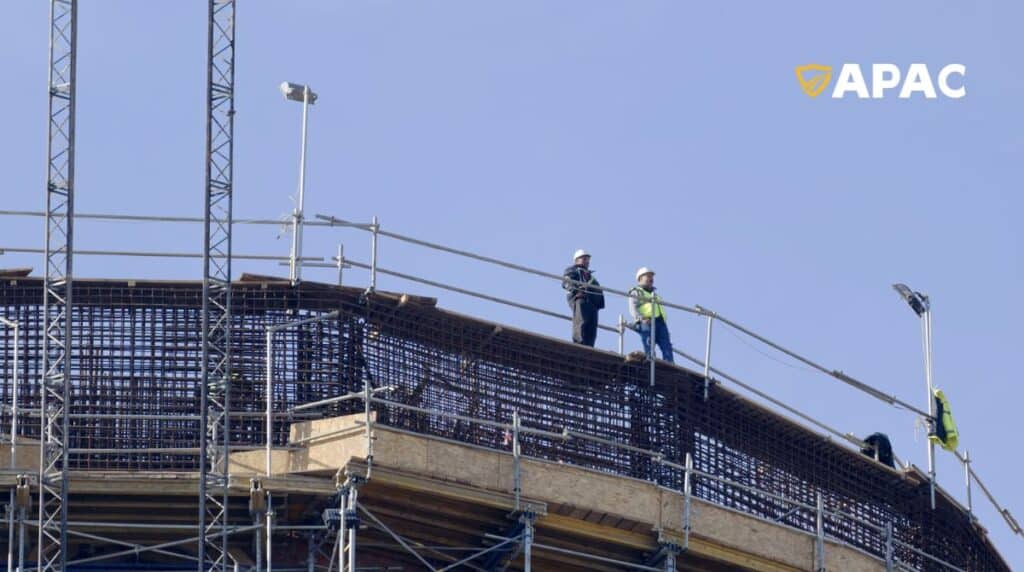
Guardrail and roof edge protection systems are used on roofs, parapets, platforms, maintenance walkways, and other exposed areas where workers may need temporary or long-term protection.
Roof edge protection is especially important during roofing work, maintenance work, solar panel installation, and building refurbishment. HSE guidance notes that where there is a risk of falling more than two metres, roof edge protection normally includes suitable guardrails and toe boards.
Common applications include:
- Roof edges
- Parapet walls
- Maintenance walkways
- Industrial platforms
- Plant areas
- Commercial rooftops
- Temporary site perimeters
- Solar panel installation areas
Typical guardrail and roof edge protection products include:
- Base Guardrail System
- Grabber Guardrail System
- Parapet Guardrail System
- Roof Guardrail System
Depending on the site condition, guardrail systems may be fixed using a base, grabber, parapet clamp, or roof-mounted system. Some systems may be designed for temporary construction use, while others are more suitable for maintenance access or long-term roof safety.
OSHA’s construction fall protection rules also set performance requirements for guardrail systems, including strength requirements for top rails. For international projects, buyers should always confirm which safety standard applies in the target market before selecting a guardrail or roof edge protection system.
How to Choose the Right Edge Protection System
Choosing the right edge protection system is not only about product price. The system must match the structure, fixing condition, construction stage, safety requirement, and project environment.
Here are the key questions to consider.
1. What Structure Are You Fixing To?
The first question is: what is the edge protection system fixed to?
Different structures require different systems:
- Concrete slab: concrete edge protection
- Steel beam: steel structure edge protection
- Stairway: stair edge protection
- Formwork beam: formwork edge protection
- Sheet pile or trench edge: excavation edge protection
- Between slabs: compression post system
- Roof or parapet: guardrail or roof edge protection
A system designed for concrete may not work properly on steel. A roof guardrail may not be suitable for a trench edge. Matching the system to the fixing structure is the first step in safe and efficient selection.
2. Is Drilling Allowed on Site?
Some projects allow drilling and anchor fixing. Others do not.
If drilling is allowed, bolt-down systems may be suitable for concrete surfaces. If drilling is not allowed, contractors may need to consider slab grab systems, beam clamp systems, compression posts, parapet guardrails, or freestanding guardrail solutions.
This is especially important for finished surfaces, renovation works, roof areas, and projects where structural damage must be avoided.
3. What Stage of Construction Is the Project In?
The construction stage also affects system selection.
For example:
- During formwork stages, beam clamp edge protection may be required.
- During concrete frame construction, slab edge protection may be more suitable.
- During steel erection, I-beam clamp systems may be needed.
- During excavation, trench guard or sheet pile protection may be required.
- During roof maintenance, roof guardrail systems may be more appropriate.
The right edge protection solution should follow the project sequence and move with the work process.
4. Does the System Need to Be Reused?
For contractors, rental companies, and distributors, reusability is an important factor.
A modular edge protection system can be moved from one area to another, reused across different floor levels, and redeployed on multiple projects. This can help reduce inventory pressure, simplify storage, and improve long-term cost efficiency.
When comparing edge protection systems, buyers should consider:
- Ease of installation
- Reusability
- Compatibility with different structures
- Packing and transport efficiency
- Replacement parts availability
- System drawings and installation guidance
A lower purchase price does not always mean lower total project cost.
5. What Safety Standard or Market Requirement Applies?
Different markets may have different safety requirements for edge protection and guardrail systems.
For example, EN 13374 covers temporary edge protection systems, product specifications, and test methods for construction and maintenance applications. In the United States, OSHA provides criteria and practices for fall protection systems used in construction.
For buyers, this means the selected system should match the requirements of the target market. Before purchasing, it is important to check whether test reports, drawings, installation instructions, and compliance documents are available.
Common Mistakes When Selecting Edge Protection Systems
Choosing by Price Only
Price is important, but it should not be the only factor. A low-cost system may not match the site structure, fixing method, or required safety performance. If the system is difficult to install or not compatible with the project, it may create additional costs later.
Ignoring the Fixing Surface
One of the most common mistakes is choosing a system without confirming the fixing surface. Concrete, steel, formwork, roof, parapet, trench, and stair structures all require different solutions.
Before selecting a system, buyers should clearly identify where the system will be installed and how it will be fixed.
Not Considering Reuse and Logistics
For contractors handling multiple projects, storage, transport, packaging, and reuse are also important. A modular system that is easy to stack, transport, and reinstall may provide better long-term value than a system designed only for one application.
Overlooking Documentation
For professional construction projects, documentation matters. Buyers may need product drawings, installation instructions, test reports, material information, and compliance documents for project approval or site safety review.
A reliable edge protection supplier should be able to support the buyer with technical information, not only hardware.
Conclusion
There are many different types of edge protection systems, and each one is designed for a specific structure or application. The main types include concrete edge protection, steel structure edge protection, stair edge protection, formwork edge protection, excavation edge protection, compression post systems, and guardrail or roof edge protection systems.
The best system depends on where it will be installed, how it will be fixed, what stage of construction it will be used in, and which safety requirements apply to the project.
In most construction projects, there is no single edge protection system suitable for every condition. The right solution starts with understanding the structure, the fixing method, and the project environment. A modular and well-matched edge protection system can improve safety, simplify installation, and support efficient project delivery.
For contractors, distributors, and construction teams looking for reliable edge protection solutions, selecting the right system is not just a safety decision. It is also a procurement decision, a logistics decision, and a long-term project efficiency decision.
 EN
EN  SV
SV  IT
IT  FR
FR  ES
ES  AR
AR  DE
DE  FI
FI  LV
LV  ET
ET